You're Not as Good at This as You Think: The Psychology of Overconfidence at the Casino
There's a particular kind of confidence that settles in after a winning streak. You start to feel it — a quiet certainty that you've somehow cracked it. Maybe you've found the right slot, or you've been watching the roulette wheel long enough to spot a pattern. Maybe you always bet on red after three blacks in a row, or you've got a specific order in which you place your chips. Whatever the ritual, it feels meaningful. It feels like skill.
Spoiler: it almost certainly isn't.
This is the illusion of control — a well-documented psychological phenomenon where people believe they can influence outcomes that are, in reality, entirely governed by chance. And in the context of UK casino gaming, it's arguably one of the most financially damaging biases a player can carry through the door (or tap onto their screen).
What Is the Illusion of Control, Exactly?
The term was first coined by psychologist Ellen Langer back in the 1970s, following a series of experiments that showed people consistently behaved as though they could influence random outcomes — particularly when the situation had any surface-level resemblance to a skill-based task.
Think about that for a moment. If a game looks like it involves skill, or if you're allowed to make choices within it — picking your numbers, pressing a button yourself rather than using auto-play, choosing which cards to hold — your brain quietly upgrades your perceived level of control. Even when the underlying result is entirely random.
For British gamblers, this plays out in countless familiar ways. The punter who always picks their own lottery numbers because letting the machine do it feels like giving up. The slots player who refuses to use the auto-spin function because pressing the button themselves feels more deliberate. The poker player who reads skill into a series of wins that were, honestly, mostly luck.
The British Angle: Stoicism, Self-Reliance, and a Stubborn Belief in Being Good at Things
There's something culturally specific going on here, too. British people — broadly speaking — tend to value self-reliance and competence. We're not particularly comfortable admitting we don't know what we're doing. We'd rather quietly muddle through than ask for directions, metaphorically or otherwise.
In a gambling context, this plays out as a reluctance to accept that outcomes are beyond our control. Admitting that the roulette wheel doesn't care how long you've been watching it, or that the slot machine has no memory of your last spin, can feel almost defeatist. So instead, we construct explanations. We find patterns. We develop systems.
And the casinos — both physical and online — are very good at creating environments that encourage exactly this kind of thinking. The ability to choose your own numbers, to select paylines, to pick which bonus box to open: none of these meaningfully change the odds, but they all make you feel more involved. More in control. More skilled.
Pattern Recognition: A Feature That Became a Bug
Here's the thing — your brain's ability to spot patterns is genuinely impressive. It's one of the reasons humans have done so well as a species. The problem is that this pattern-recognition system doesn't switch off when there are no actual patterns to find.
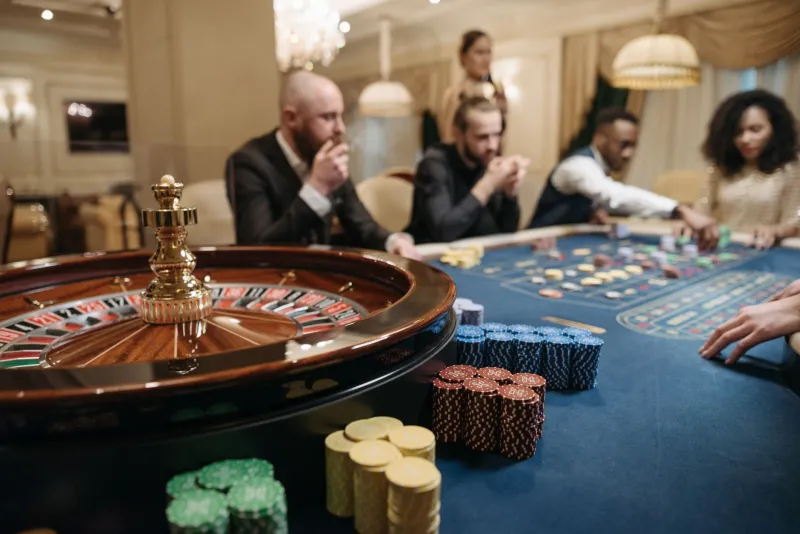
Sit at a roulette table long enough and you'll start to see sequences. Red comes up five times in a row and it feels significant. Surely black is due? (It isn't. The wheel has no memory. Each spin is independent.) Spot what looks like a cold slot machine and move to a different one, assuming the other is about to pay out. (It won't. The RNG — random number generator — doesn't work that way.)
This is sometimes called the gambler's fallacy, and it's closely related to the illusion of control. Together, they form a particularly stubborn pair of cognitive biases that are very hard to shake, even when you intellectually understand how probability works.
Rituals, Lucky Charms, and the Comfort of Routine
Let's talk about rituals, because this is where the illusion of control gets genuinely fascinating. A significant number of regular gamblers — in the UK and elsewhere — have pre-game habits they swear by. A particular seat at the poker table. A specific order for placing bets. A lucky coin or a certain song playing in their earphones.
Now, there's nothing inherently wrong with rituals. They can help you focus, calm nerves, and establish a consistent mindset. The problem comes when the ritual stops being a comfort and starts being a strategy. When you genuinely believe that doing things in a specific order will influence a random outcome, you've crossed a line.
And because rituals occasionally seem to work — because sometimes you do win after following them — confirmation bias steps in to cement the belief. You remember the wins that followed the ritual. You quietly forget the losses.
When Informed Play Becomes False Confidence
To be fair, not all gambling is purely random. Poker involves real skill. Sports betting rewards research and knowledge. Even blackjack has a statistically optimal basic strategy that can reduce the house edge. So the idea that skill plays some role in gambling isn't entirely wrong.
The danger is when players transfer this logic to games where it simply doesn't apply — or when they overestimate how much their skill matters even in the games where it does. A poker player who wins three sessions in a row might start to believe they're significantly better than they are, taking on higher-stakes games before their actual skill level justifies it.
Asking yourself a few honest questions can help:
- Could a complete beginner produce the same result by chance? If yes, your skill may be less relevant than you think.
- Am I explaining my losses with bad luck and my wins with good play? That's a classic sign of attribution bias.
- Have I changed my strategy based on recent results, rather than actual logic? Chasing patterns is a red flag.
- Do I feel like I've 'figured out' a slot machine or roulette wheel? If so, it's worth pausing — you haven't.
Reclaiming a Realistic Relationship with Chance
None of this means gambling isn't enjoyable, or that you should approach every session with grim fatalism. The point isn't to suck the fun out of it — it's to play with clear eyes.
Understanding that you're not in control of random outcomes is actually quite liberating. It means you can stop trying to game the ungameable and focus instead on what you can control: your budget, your time limits, your emotional state when you sit down to play, and when you decide to walk away.
The players who do best over time — in terms of enjoyment and financial sustainability — are generally those who've made peace with uncertainty. They play within limits they've set in advance, they don't chase losses, and they don't mistake a lucky run for evidence of superior skill.
Being honest with yourself about the role of chance isn't pessimism. It's just playing smart. And at VeryWell Casino UK, that's exactly the kind of approach we think is worth encouraging.
If you're concerned about your gambling habits or feel like your play has moved beyond healthy entertainment, tools like deposit limits, reality checks, and self-exclusion are available through any licensed UK operator. GamCare (gamcare.org.uk) also offers free, confidential support.